Okim
Gate CrashersOkim is the frozen planet at the center of one of the novel’s clearest chains of technological intervention, environmental crisis, and institutional failure. Once a living world whose society rapidly embraced industrial progress, it became a snowball planet after its inhabitants tried to regulate their climate with enormous orbital sun-weeds. Its catastrophe is not merely a remote disaster: the evidence gathered at Okim helps determine whether humanity will be blamed for the geocide of several worlds, while the planet’s surviving population remains stranded in the consequences of a solution that was meant to preserve prosperity.
Discovery and Physical Condition
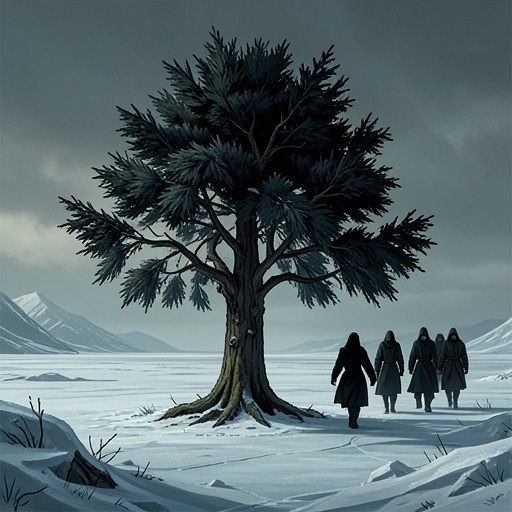
Okim enters the story as a planet within the habitable zone of the Twinkling Star, though that description has become painfully obsolete. When Jacqueline Dorsett collects a sample and the human ships approach the world, its surface is found to be frozen solid. Atmospheric carbon dioxide is nearly two thousand parts per million, yet there is no recent volcanic activity to explain the concentration, and the planet’s albedo is unnaturally uniform. The combination presents a geological mystery: Okim has the signature of an altered climate, but not the ordinary planetary processes that would account for it.
The view from orbit makes the scale of the intervention visible. Enormous membranes circle the star, reducing the energy reaching Okim and transforming its sun into the “Twinkling Star” observed by the visiting crews. The orbital structures are not inert shades or conventional satellites. They are self-replicating, quasi-organic machines whose runaway growth has made the planet’s freeze effectively planetary in scope. The spectacle is later rendered as a gargantuan red-hot inverted cone rising beyond the horizon, a visual reminder that Okim’s disaster is not confined to an invisible atmospheric statistic but has remade the sky itself.
From Contact to Industrial Acceleration
Okim was still a pre-nuclear society only a few hundred cycles before the human expedition. Its transformation began when an Assembly survey vessel suffered catastrophic pressure loss in orbit and its crew died. The vessel became a new star in the night sky, and the Okim quickly used telescopes to recognize that it was an artificial object. Curiosity became acceleration: within a century they launched a capsule to investigate the wreck, a research team was living aboard it a decade later, and by the end of that cycle the Okim had landed there.
The technological knowledge gained from the survey ship caused their development and industry to explode. Their population doubled within a generation, and their demands for energy and resources expanded with it. They exploited large hydrocarbon reserves and built huge cities. The sequence is important because Okim’s ecological collapse does not begin with primitive ignorance or deliberate self-destruction. It begins with contact, discovery, rapid growth, and the assumption that each new technical problem can be met by another technical solution.
Industrial pollution destabilized the environment. Temperatures rose, and coastal regions flooded, creating a crisis recognizable to the human visitors even across the distance between civilizations. Rather than reduce their pollution by lowering their standard of living, the Okim chose to reduce the amount of sunlight reaching the planet. The sun-weeds appeared to offer an ideal compromise: prosperity could continue while the star’s energy was dialed down enough to counteract warming.
The Sun-Weed Failure
The sun-weeds became catastrophic because their reproductive mechanism had not been tested under the precise combination of conditions found in orbit. Their designers had tested it in low temperature, microgravity, and high radiation separately, but not all three simultaneously. In space, the untested interaction produced a design fault—a kimro in the explanation offered to the visitors—and the machines began reproducing exponentially.
The resulting failure converted a climate-control system into an autonomous planetary force. The sun-weeds’ growth was fueled by a modified photosynthetic process, so the Okim could not simply remove the structures once the malfunction became apparent. By the time they understood what had happened, the weeds were growing faster than they could be destroyed. Their attempted remedy therefore became self-reinforcing: the machinery built to moderate the climate blocked more light, the world froze, and the structures continued to multiply.
Okim’s fate illustrates the danger of treating complex ecological systems as adjustable machines. The problem was not only that the Okim made a mistake; it was that their intervention created a process whose speed and energy exceeded their capacity to govern it. The novel places this failure beside humanity’s own climate anxieties, making Okim a future-like mirror rather than an alien curiosity. Its history suggests that postponing painful changes in the name of preserving prosperity can produce a crisis in which even more drastic intervention arrives too late.
Survivors, Delay, and Political Neglect
The Okim did not become entirely extinct. Once the scale of the catastrophe was recognized, the Assembly sent relief vessels to relocate the survivors, but only a few thousand remained. Plans were then drawn to destroy the sun-weeds and begin the planet’s recovery. Those plans repeatedly stalled because the weeds proved resilient and the Okim living in exile possessed little political influence. Whenever the effort lost momentum, the sun-weeds replenished themselves, returning the problem to its starting point.
This repeated return to “square one” gives Okim a distinctly administrative form of tragedy. The initial disaster is spectacular, but the continuing catastrophe is sustained by delay, insufficient resources, weak representation, and the disappearance of urgency. The planet is not simply destroyed once; it is repeatedly abandoned to the same condition. The Assembly’s relief effort demonstrates that rescue is possible, yet the inability to maintain the recovery program turns survival into a prolonged political vulnerability.
Okim also becomes part of the investigation into the destruction of Culpus-Alam and Kulla. D’armic argues that the human vessel Bucephalus is physically incapable of creating the high-space portals large enough to destroy those planets, while the patrol cruiser commanded by the deceased Vel Noric possessed the necessary capability. Because D’armic witnessed the physical evidence and redirected his investigation away from the humans, Okim functions as more than a ruined setting: it is a crucial piece of material evidence in a contested interstellar crime. The investigation later stalls because much of the admissible evidence and many witnesses are gone, allowing the Assembly to let the episode fade from public scrutiny.
Narrative Significance
For Allison Ridgeway and the human expedition, Okim is both a site of danger and a source of testimony. Allison insists that D’armic must be kept alive because he is the only witness to what happened there and an officer of the Assembly; without him, humanity may be unable to clear its name. The planet therefore links ecological disaster to political accusation. Its frozen surface is evidence of a larger history, but evidence can be suppressed, misread, or lost when institutions have already committed themselves to a convenient explanation.
Okim also exposes the contrast between technological capability and technological wisdom. The Assembly’s survey vessel unintentionally transformed Okim by making advanced science available; the Okim then used that knowledge to produce an industrial boom and an ecological disaster; later institutions attempted to manage the result but failed to sustain the remedy. The chain crosses generations and civilizations, showing how risk travels beyond the people who create it and how responsibility becomes difficult to assign once the original actors are dead or displaced.
The planet’s significance finally extends to Earth. D’armic recalls that his own people once delayed acting until the last possible moment, even while some denied or dismissed the damage they had caused. Okim thus becomes an implicit warning to humanity: climate catastrophe is not avoided merely because a civilization possesses advanced tools, and intervention undertaken to protect an existing way of life may magnify the danger if its secondary effects are ignored. Its frozen world stands as a warning against confusing control with understanding, and against assuming that a disaster can be postponed without becoming harder for anyone to reverse.